What’s it all about? I have a pretty good idea, I think. As I’ve aged, some things about being alive have become clear to me and I want to note it down here for the record.
We are all creatures shaped by our DNA, which is a simple yet infinitely variable combination of nucleotide bases (which have been found in meteorites, so they exist all over the cosmos), phosphates and sugars. That determines our characteristics: skin, eye and hair color, height, personality, susceptibility to various diseases, intelligence etc. But that’s not all we are. Also inside us is something that seems to be separate to our physical and even mental selves, and this is consciousness. With training and/or meditation, we can lift away from the body’s physical and emotional preoccupations into a realm of pure consciousness, where we can witness the person and their life, as if from afar. Whole religions are based on this phenomenon, especially in the East.
What would we be without this consciousness? We’d be automata, robots, zombies. We’d be a bit like other animals, alive yet largely unaware. Caveat: I believe animals do have some level of consciousness, a level of self-awareness you can see in some of their behaviours, but for the most part, they don’t. Life passes mostly unrealized in animals. It’s like that great line Karen Black delivers in The Great Gatsby: “You’re so dumb you don’t know you’re alive”.
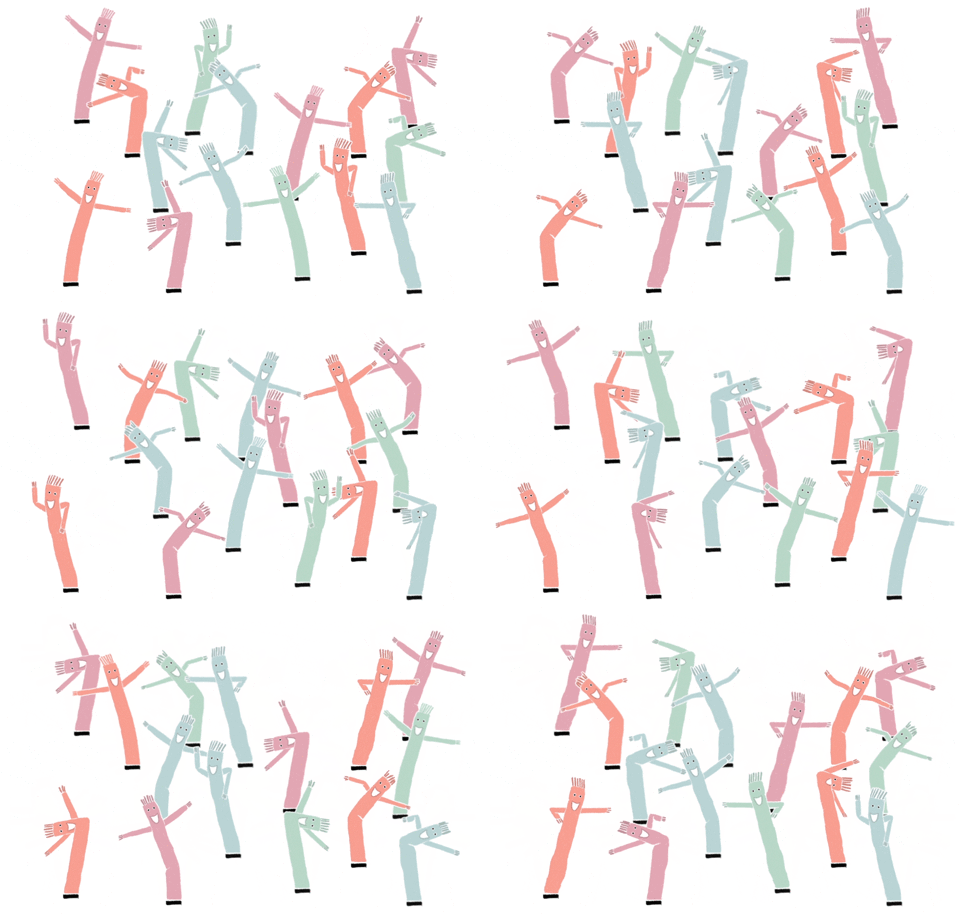
Consciousness vivifies us like fans, blowing air, animate air dancers (inflatable tube men). When it departs, the spark leaves us, and we die.
But where does this consciousness come from? People have speculated that it is everywhere present in the Universe, like gravity, and we pick it up as a radio would pick up a broadcast signal. Gravity, which undeniably exists, is still largely a mystery, and so why not consciousness too? As humans, our ‘consciousness antennae’ are the most advanced on Earth, yet some animals clearly also have vestigial antennae, for instance chimpanzees, and even to a lesser extent our pet dogs and cats, and many other animals that are clearly sentient beings to a greater or lesser extent. So consciousness is not unique to human animals. It may even be a part of plants, to some tiny extent, and perhaps all matter, even rocks, but infinitesimally so.
Therefore, when we die, the most vital part of us, Consciousness, the vivifying factor, is not lost, but is simply no longer instantiated in us. The only part that is lost is the DNA-scripted husk, the fleshy shell — a trivial thing. Therefore, in some sense we never die.
Our individual lives are thus much as philosopher Alan Watts postulated. Watts maintained that “the important You is perfectly indestructible”. Watts saw the person, the ego, the identity, as essentially illusory, a weaving of smoke in the sunlight. So at death, there is nothing lost. Watts saw our comings and goings as a sort of mirage, and said that the more we know about the world, the more diaphanous it seems, citing modern physics and the constant interchange of subatomic particles. He frequently cited human life as being a waveform, energy, molecules in our bodies changing all the time, but the DNA pattern persisting.
Everything’s vibrating, and therefore everything in the world has the characteristics of smoke. You know when you blow a cigarette or pipe or something in a cloud of smoke, and you see it in the sunbeam and it’s full of whorls and designs and all kinds of marvellous things going on, and then slowly it disappears … well, everything’s just like that. Now there are two attitudes you can take to that state of affairs. You can say sour grapes, it’s all a lousy wretched trap, and here I am, I’m given all these feelings of love and attachment and joy of life, and then I fall apart, my teeth drop out, my eyes become feeble, I get cancer or cirrhosis of the liver, or something, and then it all falls apart, and it’s too bad. Therefore don’t become attached to things, don’t enjoy life, treat it by holding it off like that, just like a very, very firm person who’s been jilted, and says “Never again will I get mixed up with the opposite sex, or with love, because love hurts!” But on the other hand, a weaving of smoke can be very beautiful, provided you don’t lean on it, provided you don’t try to preserve it, catch hold of it, because then you destroy it. So exactly in the same way, there’s nothing in the way of form that you can lean on, that you can grasp, and if you see that, then the world of form is very beautiful. (Alan Watts)
Where does consciousness arise? There may be physical structures that emanate consciousness — many mysterious objects exist that seem to defy known physical laws, e.g. strange little red dots that are scattered through the Universe, with unknown purpose, origin or properties.
The appealing aspect of this envisioning of consciousness is that it makes the whole problem of what happens to individual consciousness after death moot. It never goes away, yet does not survive death as the DNA-linked person either. New forms with novel DNA constantly arise to live yet more evanescent lives, full of experiences linked to their characters, personalities, and luck, all animated by the Consciousness Waves, or ParaBrahman (the Supreme Brahman, the ultimate, transcendent reality beyond all description, form, or conception, representing absolute consciousness, the source of all existence, and the highest truth), or God (if you like).
So we are basically little bags of DNA in which life is sparked by waves of consciousness from the universe. Death loses its sting, and life’s problems fade in importance, once you accept this. It’s very liberating.
More recently, some scientists have started to recognize this theory as probable fact. In November 2025 an interesting article in the UK’s Daily Mail (paywalled) discusses this topic, much to my delight and surprise, and I’ll reproduce some of it here:
Physicist proposes radical new theory of consciousness – and it could finally explain what happens when you die

Consciousness does not emerge from human brains, according to Professor Maria Strømme, a professor of nanotechnology at Uppsala University. Instead, she claims that it exists as a fundamental field. If this is correct, ‘mysterious’ phenomena such as telepathy, near–death experiences, and even life after death could finally be explained by science.
According to Professor Strømme’s theory, consciousness does not end when we die. Instead, when a person passes away, their consciousness simply returns to the background field. Speaking to the Daily Mail, Professor Strømme explained: ‘The possibility that consciousness is fundamental has been under–explored. But that is changing rapidly.
‘We are reaching a point where asking deeper questions about consciousness is not philosophy on the margins — it is becoming a scientific necessity.’
According to more traditional theories of quantum physics, particles and energy all emerge from vibrations in a fundamental field – like how waves emerge from vibrations in water. Professor Strømme now claims that this fundamental field might be consciousness itself. If this is true, there would be radical consequences for our view of reality. Perhaps most shockingly, if this theory is correct, the separation of our individual consciousness is simply an illusion.
Professor Strømme told the Daily Mail: ‘In the model, individual consciousness is understood as a localised excitation or configuration within a universal consciousness field — much like a wave on the surface of an ocean. ‘A wave has a form that is temporary, but the water that carries it does not vanish when the wave subsides.’ What’s more, the theory suggests that consciousness does not end when we die, and instead, it simply returns to the background field. ‘The fundamental substrate of awareness does not begin or end with the body, just as the ocean does not begin or end with the appearance of a single wave,’ says Professor Strømme.
This also means that many phenomena dismissed as pseudoscience could be part of the scientific model and ‘deserve renewed, rigorous scientific testing’, according to the expert. For example, during near–death experiences, many people report having visions of religious figures, lost loved ones, or even premonitions of future events. ‘If individual awareness is not generated only by the brain, but is an expression of a deeper field, as my model suggests, then moments when the brain is impaired could allow atypical access to that underlying field,’ says Professor Strømme.
Likewise, the model suggests that psychic abilities such as telepathy may not only be real, but also scientifically testable. Since all individual consciousnesses are part of the same field, information can be transmitted between points that are apparently separated by space or even time. That means individuals who are specifically gifted or in altered states of consciousness may be able to read minds or see visions of distant events. ‘This would explain why telepathy–like phenomena appear across cultures and throughout history, even though the empirical evidence so far is controversial and not yet conclusive,’ says Professor Strømme.
If her theory is true, the brain states of those in deep meditation or ’emotional attunement’ should show evidence of ‘synchronising’ with other people’s brain activity. This evidence should show up on brain scans, allowing scientists to test whether Professor Strømme’s theory really is correct.
‘The texts of the major religions – such as the Bible, the Koran, and the Vedas – often describe an interconnected consciousness,’ the expert added. ‘Those who wrote them used metaphorical language to express insights about the nature of reality. Early quantum physicists, in turn, arrived at similar ideas using scientific methods. ‘Now, it is time for hardcore science – that is, modern natural science – to seriously begin exploring this.’
How far do you want to take this? Scientists like Michio Kaku (and others) are also getting on the bandwagon:

A groundbreaking theory gaining traction among physicists and philosophers posits that consciousness, rather than matter, forms the fundamental substrate of reality. Known as ontological idealism or consciousness-first cosmology, it inverts the conventional materialist paradigm that has dominated science since Newton. Instead of atoms, fields, or quantum wavefunctions being the ultimate building blocks from which mind somehow “emerges,” this view argues that primordial consciousness is the ground of all being, and what we call the physical universe is a structured appearance within or manifestation of that consciousness.
Proponents point to persistent failures of materialism: after centuries of research, science still cannot explain how subjective experience (qualia) arises from purely objective processes in the brain. The “hard problem of consciousness” remains unsolved. Meanwhile, quantum mechanics reveals that observation itself seems to play a constitutive role in determining reality (as seen in wave-function collapse interpretations), suggesting mind is not a late-stage byproduct but an intrinsic feature woven into the cosmos from the start.
In this framework, space, time, energy, and matter are not independent entities but stable patterns or “excitations” within universal consciousness, much like images arise on a screen without the screen being made of images. The Big Bang becomes not the origin of matter from nothing, but the awakening or self-differentiation of a singular cosmic awareness. Individual minds are localized perspectives of this one underlying consciousness, explaining phenomena like non-local correlations in quantum entanglement and certain paranormal reports that materialism struggles to accommodate.
Though still speculative, the theory elegantly resolves multiple philosophical and scientific paradoxes while aligning with ancient wisdom traditions that have long claimed “all is mind.”
Update: the articles are suddenly coming thick and fast in the popular press. This from The Daily Mail:
Consciousness can connect you to the entire UNIVERSE, radical theory suggests
Published 20 February 2026Your consciousness can connect you with the entire universe, a groundbreaking study suggests. Experts from Wellesley College in Massachusetts claim that traditional connections in the brain cannot fully explain how we are aware of our existence. Instead, they argue that quantum physics taking place within our skull is what generates awareness. This includes the idea that particles can exist in multiple states and locations at the same time. As a result, our consciousness can hypothetically connect with consciousness across the world and even the universe, they argue. And it could turn traditional theories, that have persisted for decades, on their head.
‘When it becomes accepted that the mind is a quantum phenomenon, we will have entered a new era in our understanding of what we are,’ said Professor Mike Wiest, an author of the study. A quantum understanding of consciousness ‘gives us a world picture in which we can be connected to the universe in a more natural and holistic way’, he added.
Researchers carried out a study to investigate how anaesthesia affects the brain. They gave rats a drug that attached to tiny neural structures called microtubules, and then exposed the animals to an anaesthetic gas. They found that these rats took much longer to become unconscious than usual. This suggests that the drug was blocking or interfering with how the anaesthesia normally works. Since there isn’t an obvious explanation for how this happens, Professor Wiest believes the results support the idea that consciousness may involve quantum processes in the brain. If this turns out to be correct, it could completely change our understanding of the phenomenon and strengthen the theory that consciousness is capable of being in all places at the same time.
A study, published in 2024, suggested that myelin – a fatty, insulating layer wrapped around nerve fibres in the brain – provides the ideal environment for quantum processes. However, many scientists scorn the idea – as quantum effects have so far only been produced in the lab under extremely cold temperatures.
Professor Wiest’s research, published in the journal eNeuro, concludes with the hope that there will soon be ‘conclusive experimental tests of the quantum consciousness hypothesis’.
Last week, a new study claimed that consciousness exists beyond death and the process of dying should be a ‘negotiable condition’. Traditionally, death has been defined as the irreversible loss of brain and circulatory function. But experts are beginning to challenge this view – arguing that consciousness can persist even when the brain stops working.
A researcher from Arizona State University carried out a large–scale review of dozens of studies that focused on what happens when people ‘die’. This included publications on near–death experiences, research on the electrical brain activity of dying patients and clinical studies of conscious awareness during heart attacks. Analysis revealed that across heart attack studies, 20 per cent of survivors recall conscious experiences during periods when the brain had stopped working. Brain recordings in dying humans and animals document surges of activity surpassing baseline waking levels, they found. Meanwhile some patients who have experienced ‘complete circulatory standstill’ – when the heart stops beating – later demonstrated implicit recall of what was going on around them.
Laboratory work has also demonstrated that metabolism, brain activity and blood flow can be restored in mammal brains and organs ‘well beyond accepted limits’. This reveals that ‘biological death is not immediately irreversible’, Anna Fowler, from Arizona State University, said. ‘Emerging evidence suggests that biological and neural functions do not cease abruptly,’ she told the American Association for the Advancement of Science (AAAS) conference in Phoenix, Arizona. ‘Instead, they decline from minutes to hours, suggesting that death unfolds as a process rather than an instantaneous event. Elements of consciousness may briefly exist beyond the measurable activity of the brain and death, long considered absolute, is instead a negotiable condition.’